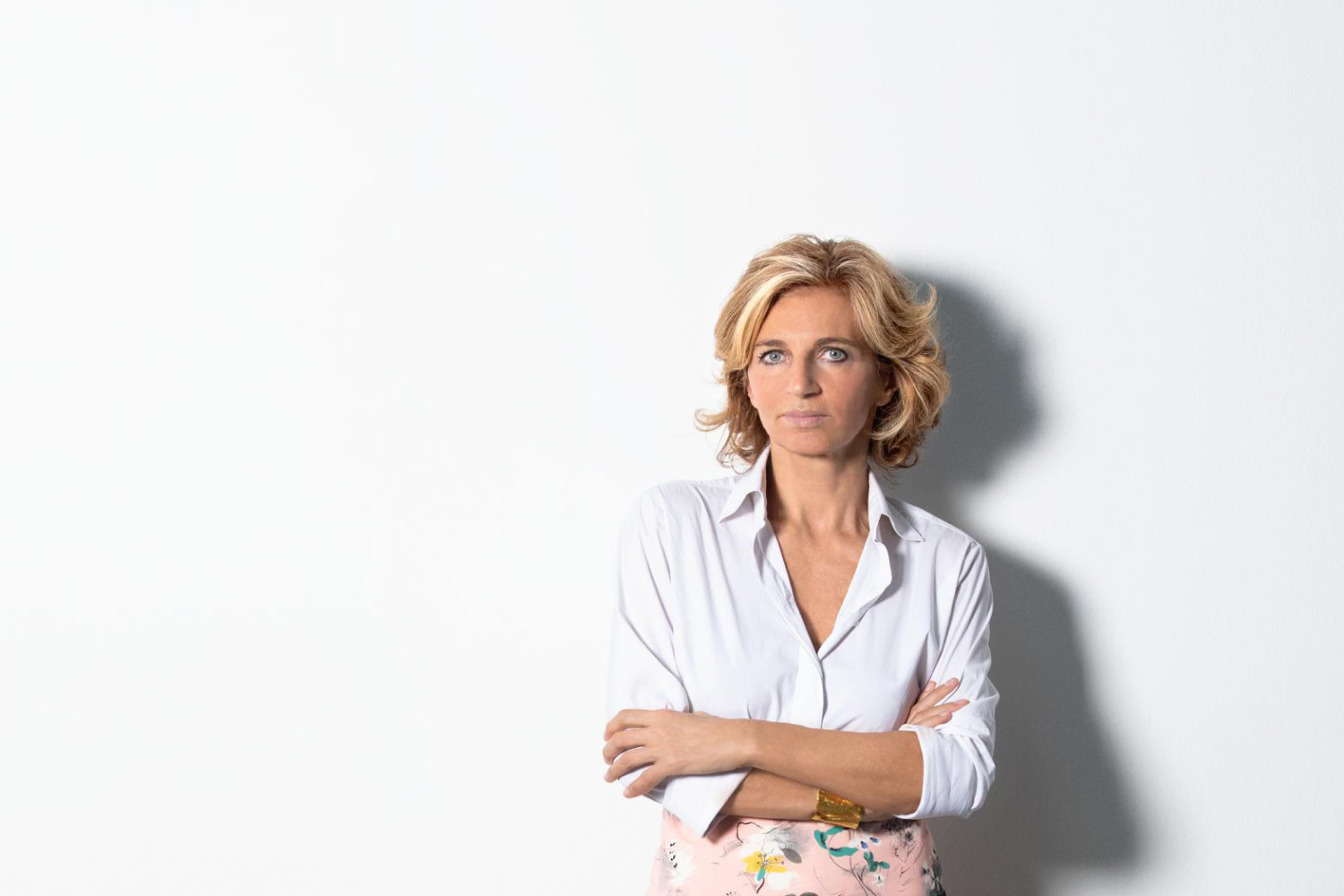

Elena Tettamanti tells of her experiences going from curatorship to cultural enterprise - Interview of Elena Tettamanti from Espresso Weekly Magazine
Architect by training, curator by vocation, entrepreneur by vision, Elena Tettamanti is a role model for art project creators in Italy.
Her work spans across art, design, architecture, and patronage. It distinguishes her ability in combining cultural vision, managerial pragmatism, and an in-depth focus on sustainability and social impact, which have become key in the relationship between culture and business.
Elena Tettamanti’s curatorial expertise has been backed by a rigorous managerial organisation: from the exhibition Trame. Le forme del rame (textures. The Shapes of Copper) at the Triennale di Milano, to Ca’ Corniani. Terra d’avanguardia (Land of the Avant-garde) project, to mention just a few, up to the recent anthological exhibitions dedicated to Mario Nigro and Remo Salvadori.
This found a significant acknowledgment in the patronage model of the Associazione Amici della Triennale (Friends of the Triennale Association), of which she was the founder and President, and for which she served on the Board of Directors (CdA) of the Triennale Milano. A case study in the Italian cultural patronage, awarded with the Ambrogino d’Oro by the Municipality of Milan.
You started as an architect but today you are recognized as a curator and an authority and reference in the cultural patronage. How have you intertwined these two elements in your career path?
My initial training as an architect allowed me to develop an interdisciplinary vision of my curatorial work both on the subject of exhibitions dealt with from different perspectives and on public art projects. For example, copper in its different applications as in the exhibition Trame. Le forme del rame tra arte contemporanea, design, tecnologia e architettura (Textures. The Shapes of Copper among contemporary art, design, technology and architecture) and in the international context “Ca Corniani Terra d’avanguardia” (Ca’ Corniani Land of the Avant-garde). In this project contemporary art, through the concept of “threshold”, was used to build a new relationship between nature, the community that inhabits it and the visitor.
In cultural patronage, the transversality of the approach was mainly shown in contemporary subjects: the city, the environment, the sustainability and technology, which allowed me to create projects, primarily dedicated to young people, in a fruitful collaboration between public and private sectors.
You founded Eight Art Project and chaired the Associazione Amici della Triennale. How did you come about the idea of “applying culture as a business” related to these two experiences.
The former (Eight Art Project) allowed me to manage and execute cost-effective projects. Eight Art Project is the company that covers the entire project cycle: from concept to realization, managing collaborations between the public and private sectors.
The latter (Associazione Amici della Triennale) allowed me to create a new model of cultural patronage, based on the active participation of corporate and individuals in projects primarily aimed at young people in the educational, innovation, and sustainability areas, and above all having a significant social impact. This created a genuine community involving thousands of people inspired by cultural promotion and educational goals.
The true driver of contemporary patronage, however, remains the ability to build lasting alliances among institutions, businesses, and individuals, founded on a shared vision for the common good. Only from this perspective can culture become a form of civic investment.
How do you build today a truly active and patronage model in participation, capable of involving citizens and companies?
An active and patronage model in participation is based on the ability to create projects that go beyond mere fundraising and have a strong return for the community. The model I promoted with the Associazione Amici della Triennale provided the active participation of companies and private individuals, directing resources towards objectives with a firm social impact
This demonstrated that patronage is effective when private intervention is aimed at transforming and enhancing the cultural and social context. The value of this model was recognized with the awarding of the “Premio Rinascimento+” in 2024, and international recognition for cultural patronage and support for art and artists.
From Mario Nigro to Remo Salvadori, your recent exhibitions describe and idea of art that dialogues with space and time. How do you create and exhibition, and what role do you attribute to the visitor’s experience?
I do not have a predefined model. I look at the artist and his history when choosing the structure and pathway of the exhibition. In the case of Mario Nigro, the exhibition was conceived in chronological order, tracing his pictorial cycles such as “total space” and “total time”, highlighting the evolution of his abstract and geometric language.
In the Remo Salvadori exhibition, however, due to the nature of his work, the traditional concept of a chronological exhibition was abandoned, focusing instead on the thematic core that represents the essence of the artist’s work.
The visitor experience is central. In the exhibition dedicated to Remo Salvadori (2025), which was an exhibition spread across several emblematic locations in Milan. The aim was to invite the visitor to enter into a relationship with the artwork.
In this case, the exhibition space was seen as an ideal extension of the artist’s studio, fostering a constant dialogue between the artwork and the host architecture.
When you conceive an exhibition, do you start more from the artist or the exhibition space?
I am always influenced at the outset by the artist’s work, as demonstrated by the exhibitions dedicated to great 20th-century and contemporary artists – and the final setup must necessarily integrate the work with the surrounding environment. I consider, the exhibition space or the place hosting the work is not a simple container, but a co-protagonist.
You work in curation with Antonella Soldaini. A collaboration consolidated over time.
That is true, we are a genuine curational duo who work in harmony and manages our contributions into a shared vision of the projects.
Today there is much talk about “cultural sustainability.” What does making an artistic project sustainable mean to you, beyond the economic aspects?
Making an artistic project sustainable goes beyond mere economic management. First and foremost, it means guaranteeing the free and inclusive enjoyment of the project, its lasting in time, and its long-term impact on the social environment.
I believe that sustainability is the ability of a project to generate value, not only artistic value, but one that also has a strong and formative social impact. This concept of cultural sustainability is an integral part of the Eight Art Project operating model.
Looking towards the future, how do you envision the role of culture in Italy, and what do you believe the new relationship between art and business should be?
The role of culture is to be placed in the relationships between businesses and their social function. Considering that the social contribution of a business is today a topic of discussion not only culturally but especially economically – thinking of corporate sustainability reports or the growth of the third sector – the new relationship between art and business should evolve towards active and transparent participation, where the company is not just a backer, but participates in projects that have an explicit and measurable social impact. From this perspective, culture is neither a cost nor an ornament, but a form of shared responsibility: a space where art, business, and society can reinvent the future together.